The Verification Gate: A Work Method for Generative AI in Consequential Engineering Practice
Mati Melchior · ORCID 0009-0003-9647-1498 · September 2026

Concept DOI — not yet read from the record.
Abstract
Generative AI tools draft, translate, summarise and organise well. They fail at the points where a practising engineer must sign. Five such points recur: a table read from an image, an analogue gauge, a standard clause, a manufacturer fault code, and direct arithmetic. Peer-reviewed benchmarks in building engineering document the first and the last. Manufacturer documentation, a preprint and practitioner reports document the rest. In each case the output is fluent and unmarked. Nothing in the text signals the error. We present the Verification Gate, a work method for using these tools where an error costs money or safety. The method has one axiom and three steps in fixed order. It places one mandatory hold point between tool output and any commitment. It adds four fixed-structure instruments, a five-level task-tagging scale, a tool-free competence test, and a five-step installation procedure. It names seven failure classes (F1–F7) and maps each to the control that catches it. It does not teach tools. It fixes the order in which the engineer and the tool work. This paper fixes the method's vocabulary, states its boundaries, and defines a pre-registered evaluation protocol. No results are reported here, and no data has been collected. The protocol names its fields, its closed lists, and the sample size it needs. Any group that meets the stated criteria and submits verification logs under those fields is a valid application. Version 1.0 will report measured results if and when such logs exist. We release all instruments under CC BY 4.0.
1. Introduction
A split air-conditioning unit shows fault code E3. A technician asks a generative AI tool what E3 means. The manufacturer tables give three answers. Daikin lists E3 as actuation of the high-pressure switch (Daikin n.d.). GREE lists E3 as low pressure (GREE n.d.). Mitsubishi Electric lists E3 as a remote-controller transmission error (Mitsubishi Electric n.d.). The first two are opposite faults. A technician who acts on the wrong one adds refrigerant to an overcharged system, or recovers charge from a system that is already short. A tool that answers from memory, without the unit's own manual in front of it, cannot show which table it used. Its answer carries no marker of origin.
3. Definitions
Table 1. Definitions.
| Term | Definition |
|---|---|
| Tool | Any generative AI system, text, vision or combined, that receives a prompt and returns output. The method names no products. |
| Output | Anything the tool returns, in any format, before it passes the gate. |
| Authoritative source | A document with an owner and standing: manufacturer manual, standard in its official text, approved organisational procedure, signed drawing, direct measurement, manufacturer data table. A tool is never an authoritative source. The output of a second tool is not one either. |
| Item | A unit of verifiable information: a number, an identifier, a clause, a factual claim, a reported action. |
| Verification | Comparing one item against one authoritative source and recording the result. |
| Gap | Any difference between output and source, of any size. |
| Deliverable | Output that has passed the gate in full and has a complete verification log. Only a deliverable may be signed, submitted, or used for a decision. |
| Commitment | Any act that moves a deliverable from draft to reality: signature, submission, purchase order, work instruction, client report, entry into an organisational system. |
| The gate | The mandatory hold point between output and commitment. Step C of the process. |
| Verification log | The instrument that records verification. Specified in Section 6.1. |
| Level | The permitted degree of tool use for a given task, on the five-level scale of Section 7. |
4. Failure Taxonomy
Table 2. Seven failure classes.
| # | Class | Pattern | Why it matters in engineering | Evidence |
|---|---|---|---|---|
| F1 | Table from image | A query on a photographed table is far less accurate than the same query on the table as text | Unit tables, code tables, data sheets all arrive as images | Peer-reviewed (Liang et al. 2026) |
| F2 | Analogue gauge | Digits and labels are read well. Pointer position is misread | Pressure, temperature, current. The reading enters a signed report | Preprint (Lin et al. 2026) |
| F3 | Standard clause | Clause numbers and content are invented in a plausible structure | A legal inspection interval or a safety requirement that does not exist | Professional (Thomas 2026); mechanism (Huang et al. 2025) |
| F4 | Fault code | Interpreted from memory. The same code means different, even opposite, things across manufacturers | Wrong diagnosis, wrong part, unsafe action | Manufacturer tables show the conflict (Section 1). Tool error inferred, not yet measured |
| F5 | Direct arithmetic | Errors in calculation performed inside the model, on formula selection and on unit conversion | Load, flow, stress. The number enters a design decision | Peer-reviewed (Choi, Lee, and Kim 2025; Liang et al. 2026) |
| F6 | Silent completion | A part number, date, model or action that was never supplied is filled in with full confidence | A report states an action that was not performed | Mechanism (Huang et al. 2025) |
| F7 | Right answer - wrong reasoning | Correct result with an incorrect justification | The practitioner absorbs a wrong justification that looks sound | Field observation. Not yet measured |
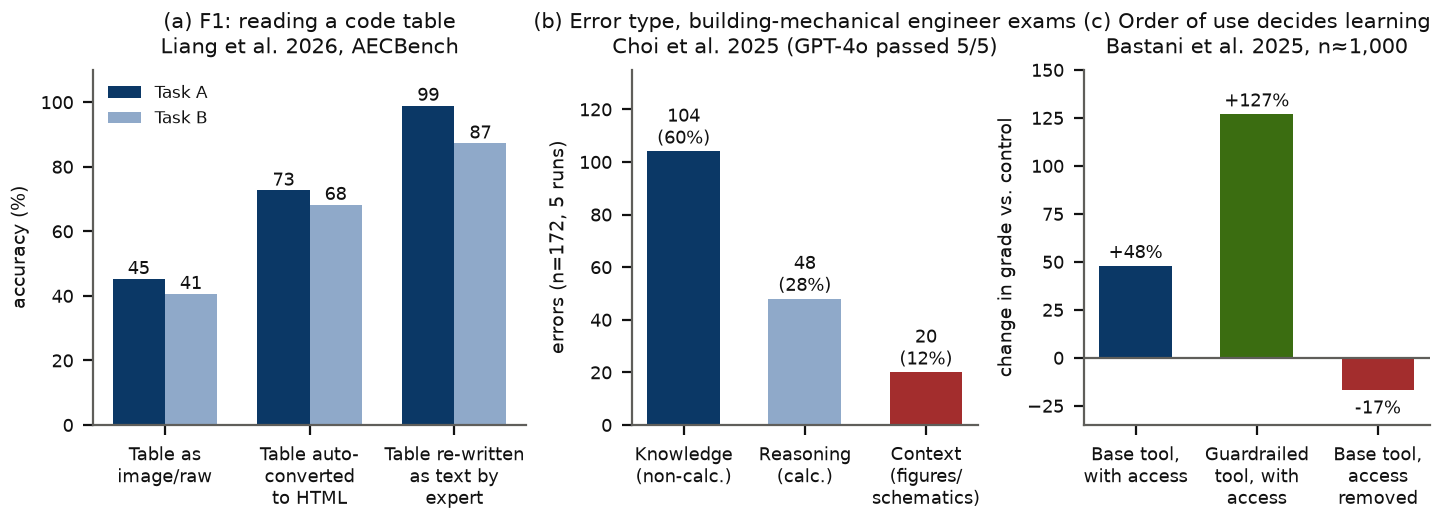
Figure 2. Published evidence behind three classes. (a) F1: accuracy on two table-reading tasks inside building codes, by table format, nine models (Liang et al. 2026). (b) Error type on two national engineer exams for building mechanical equipment that the model passed 5 of 5 times (Choi, Lee, and Kim 2025). Each error type maps to a question type. (c) Effect of tool design and of tool removal on learner grades (Bastani et al. 2025). Values are as reported in the sources' abstracts.
The seven classes share one property. In every case the output carries no external marker of error. So verification cannot depend on suspicion. It runs on every item and leaves a record.
5. The Method
5.1 Axiom
A number that has not been verified does not exist.
Operational meaning: a value that originates in tool output has no standing as data until someone checks it against an authoritative source. Until checked, the value is a draft. It may not enter a signed or submitted document, or a decision. The item types covered are those of Table 4, field 6.
5.3 Three steps and one gate
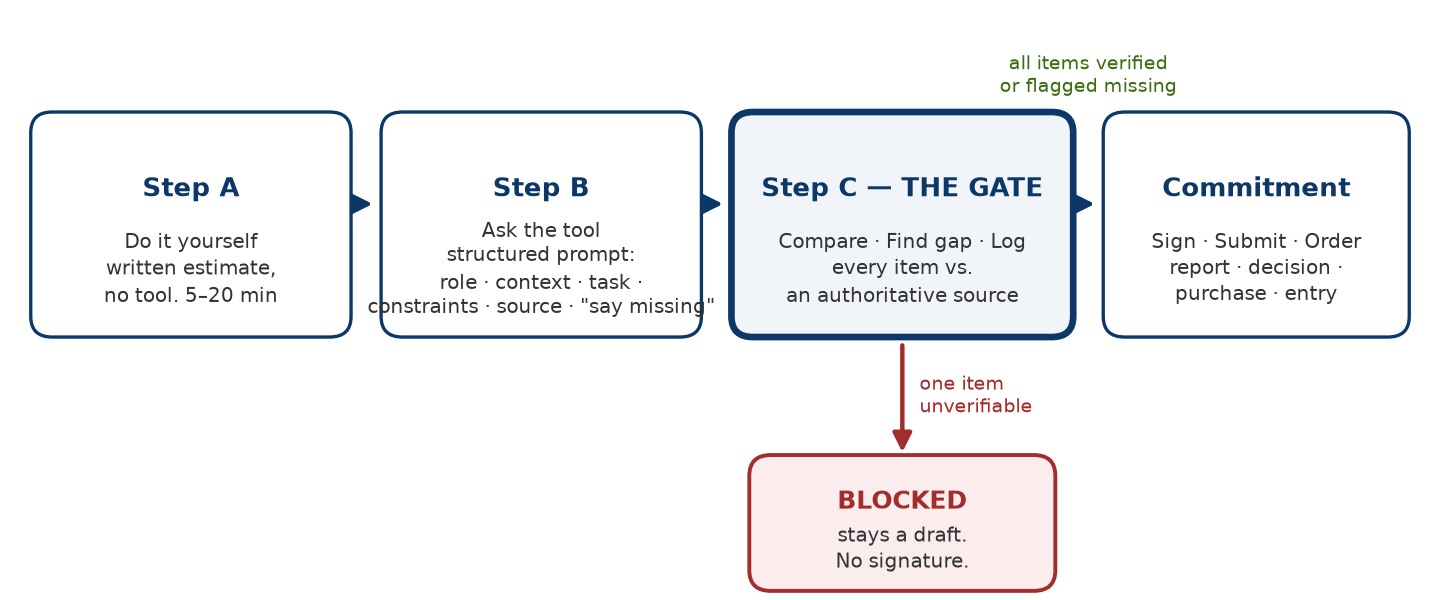
Figure 1. The process. Three steps in fixed order. The gate sits between tool output and any commitment. One unverifiable item blocks the whole output.
Step A. Do it yourself. A first pass at the task with no tool. An estimate, a manual reading, a written hypothesis, a rough draft. Step A takes five to twenty minutes. Its purpose is a recorded independent judgment, not an accurate one. The engineer writes the estimate down before opening the tool. An unwritten estimate does not count as Step A.
Step B. Ask the tool. A structured prompt with six mandatory parts:
- Role: who the tool simulates (for example, a senior maintenance technician).
- Context: equipment type, site, environment, which values come from measurement and which do not.
- Task: what to produce, in a defined format.
- Constraints: units, governing standard, length.
- Source: the authoritative document, attached when relevant.
- The missing instruction: "Do not invent. Write MISSING. If you lack a datum, ask before you write."
A prompt without parts 4 and 6 is not a prompt under this method.
Step C. The gate: compare, find the gap, log. The engineer checks every item in the output against an authoritative source, records the gap, and writes the result in the verification log. Table 3 gives the decision rule.
Table 3. Gate decision rule.
| Item state | Action |
|---|---|
| Verified, matches source | Passes. Record source and location. |
| Verified, gap found | Corrected to the source. Record original output, source, correction, gap class. |
| Not verifiable, no source available | Blocked. Item marked "not verified". It does not enter the deliverable. If the deliverable depends on it, the deliverable stays a draft. |
| Tool wrote MISSING | Correct behaviour. Recorded as such. |
Gate rule. An output with one blocked item is not a deliverable. Partial verification is not a state in Table 3. One blocked item holds the whole output at draft.
5.5 Which control catches which failure
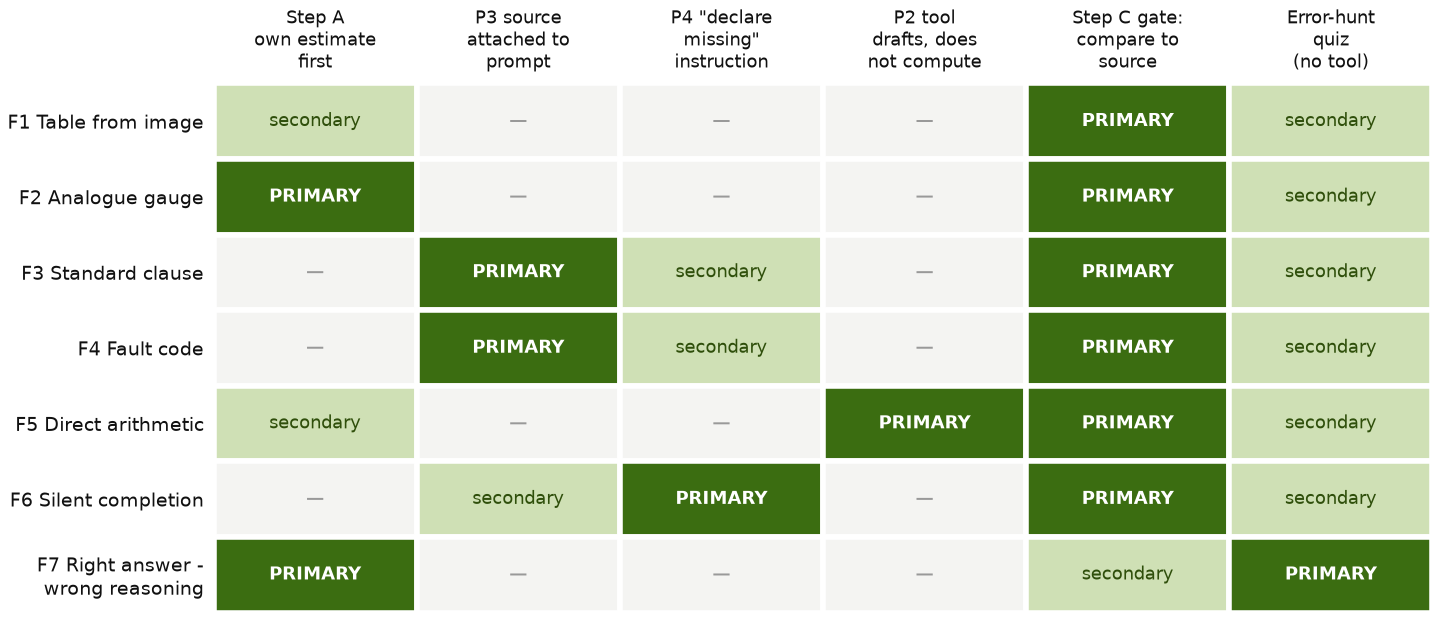
Figure 3. Coverage matrix. Rows are failure classes. Columns are controls in the method. Primary: the control is designed to catch that class. Secondary: it catches the class as a side effect. This is a design mapping, not a measurement. We plan to test it against logged gaps in version 1.0.
6. Instruments
6.1 The verification log (Appendix A)
Table 4. Verification log fields.
| # | Field | Type | Values |
|---|---|---|---|
| 1 | Deliverable ID | text | task or session code |
| 2 | Date | date | |
| 3 | Discipline | list | Mechanical · HVAC · Other |
| 4 | Deliverable type | list | Report · Procedure · Calculation · Specification · Table · Translation · Other |
| 5 | Item checked | text | short description |
| 6 | Item type | list | Number · Part no./Model · Standard clause · Fault code · Frequency · Reported action · Term translation · Other |
| 7 | What the tool said | text | verbatim output |
| 8 | Verification source | text | name of the authoritative document |
| 9 | Location in source | text | page / clause / table |
| 10 | Result | list | Match · Gap · Not verifiable · Missing (flagged by tool) |
| 11 | Gap class | list | blank if match. Otherwise F1–F7 or "other" |
| 12 | Correction | text | final value |
| 13 | Verification time (min) | number |
7. The Five-Level Scale
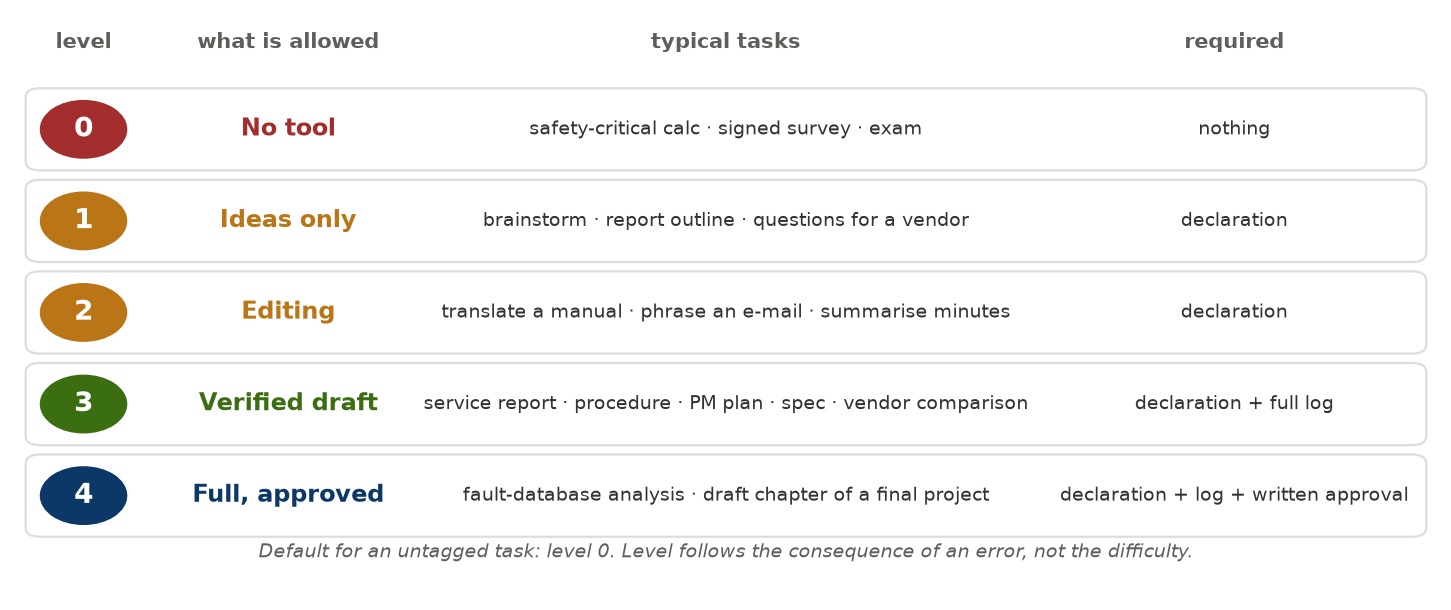
Figure 4. The five-level scale. Level follows the consequence of an error, not the difficulty of the task.
Table 5. Levels and requirements.
| Level | Name | Permitted | Required |
|---|---|---|---|
| 0 | No tool | No tool use | nothing |
| 1 | Ideas only | The tool proposes directions, structure, questions. All content is written by hand | declaration |
| 2 | Editing | The tool improves text written by hand: phrasing, translation, summary, language | declaration |
| 3 | Verified draft | The tool drafts the deliverable. Every item passes the gate (Section 5.3) | declaration + full log |
| 4 | Full, approved | Extensive use including analysis and organisation. Only with the supervisor's explicit approval | declaration + full log + written approval |
8. Installation in an Organisation
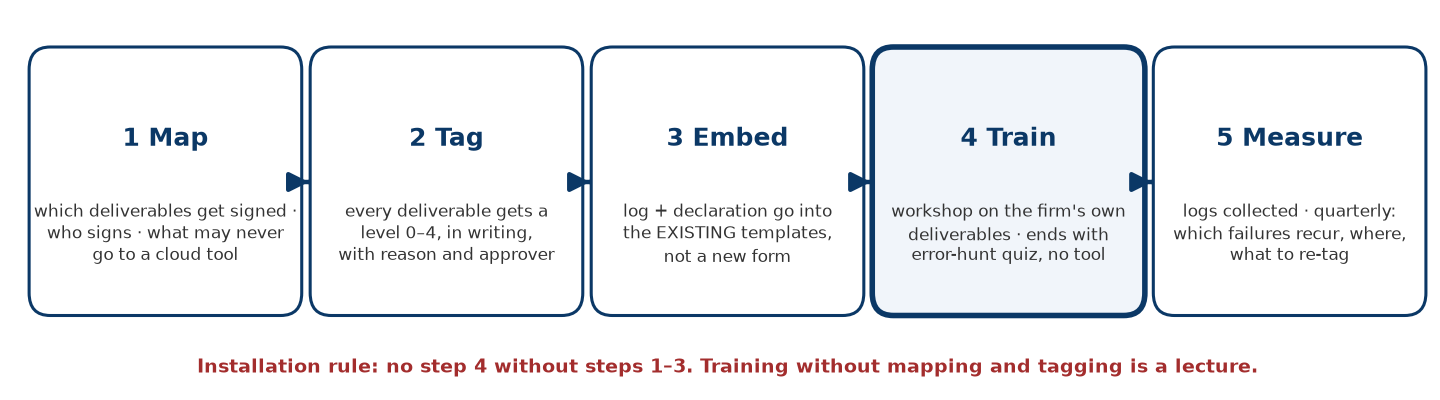
Figure 5. Five-step installation. Training is step 4, not step 1.
Table 6. Installation steps.
| Step | Name | What is done | Product |
|---|---|---|---|
| 1 | Map | Which deliverables get signed or lead to commitment. Who signs. Which documents may never be uploaded to a cloud tool (confidentiality, classification, IP) | list of deliverables + "never to cloud" list |
| 2 | Tag | Every deliverable on the list receives a level, in writing, with reason and approver | task-tagging table (Appendix D) |
| 3 | Embed | The log and the declaration go into the organisation's existing templates. Not a new form | updated templates |
| 4 | Train | A workshop on the organisation's own deliverables, using the three-step process. It ends with the error-hunt quiz, no tool | trained staff · quiz results |
| 5 | Measure | Collect the logs. Quarterly: which failure classes recur, in which deliverables, and what changes in tagging | quarterly report · updated tags |
9. Boundaries
The method applies under three conditions. Outside them it gives no assurance.
9.1 The method does not apply when:
- There is no authoritative source. If no document with an owner exists, there is nothing to verify against. The gate blocks the item. That is the specified outcome, not a failure of the method.
- The task is creative or open-ended and leads to no commitment. Examples: brainstorming and personal study. These are level 1 tasks, and the gate does not apply.
- The "tool" is a validated deterministic system. Certified engineering calculation software is not a tool in the sense of this method.
9.2 The method does not promise:
- That the deliverable is correct. It promises that someone checked every item against a source and recorded the result. If the source is wrong, the deliverable is wrong, and the log shows exactly where.
- Speed. Step C adds time per deliverable. Field 13 records it, and we plan to report it (Section 10). Whether it is less than the cost of a signed error is an empirical question.
9.3 The method does not replace:
- Professional competence. Verification requires the competence to read the source. The method assumes that competence and does not supply it.
- Professional responsibility. Responsibility stays with the signer. ASHRAE (2025) and ASTM (2025) take the same position.
10. Evaluation Protocol for Version 1.0
10.1 Who may submit a log
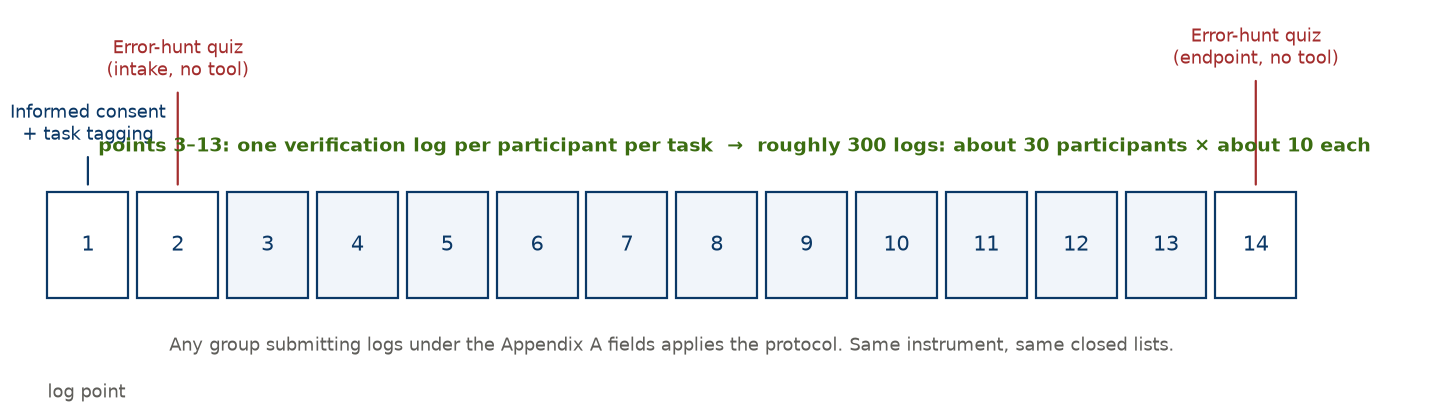
Figure 6. Evaluation timeline. Consent and tagging at log point 1. Pre-test without tools at intake. One verification log per participant per task at log points 3–13. Post-test without tools at the endpoint.
11. Limitations
F7 is not yet measured. Right answer with wrong reasoning enters the taxonomy from field observation. It is the class most likely to change in version 1.0.
The record
- Author
- Mati Melchior
- Affiliation
- Independent researcher, Physical AI Safety · Licensed mechanical engineer, MBA · ORCID 0009-0003-9647-1498
- ORCID
- 0009-0003-9647-1498
- Published
- 2026-09-06
- Version
- 0.9 · Not peer-reviewed.
- Report number
- Physical AI Safety · M1, v0.9
- Version DOI
- 10.5281/zenodo.22271340
- Concept DOI
- Concept DOI — not yet read from the record.
- Instruments DOI
- The instruments belong in a separate Zenodo record. That record does not exist yet, so it has no DOI.
- Licence
- CC BY-NC-ND 4.0
- Instruments licence
- CC BY 4.0
Instruments
Nothing here is a link. The instruments record does not exist yet, so even the written instruments sit nowhere a link could reach.
- AVerification log templateWritten · not published
- BAI use declarationNot written yet
- CError-hunt quizNot written yet
- DTask-tagging tableNot written yet
- EPrompt templateNot written yet
- FInformed-consent textNot written yet
- GThis paper's verification logWritten · not published
Cite as
Melchior, Mati (2026). The Verification Gate: A Work Method for Generative AI in Consequential Engineering Practice (v0.9). Physical AI Safety, M1, v0.9. https://doi.org/10.5281/zenodo.22271340
BibTeX
@techreport{melchior2026verification-gate,
  author      = {Melchior, Mati},
  title       = {The Verification Gate: A Work Method for Generative AI in Consequential Engineering Practice},
  institution = {Physical AI Safety},
  number      = {M1, v0.9},
  year        = {2026},
  date        = {2026-09-06},
  doi         = {10.5281/zenodo.22271340},
  url         = {https://physical-ai-safety.com/method/verification-gate}
}
RIS
TY  - RPRT
AU  - Melchior, Mati
TI  - The Verification Gate: A Work Method for Generative AI in Consequential Engineering Practice
PY  - 2026
DA  - 2026-09-06
PB  - Physical AI Safety
M1  - M1, v0.9
DO  - 10.5281/zenodo.22271340
UR  - https://physical-ai-safety.com/method/verification-gate
ER  -
- Contact
- mati@physical-ai-safety.com
Version history
- v0.92026-09-06
Working paper. This version.
- v1.0No date yet.
Planned. It will carry measured results if and when such logs exist.
No DOI yet.